


Introduction
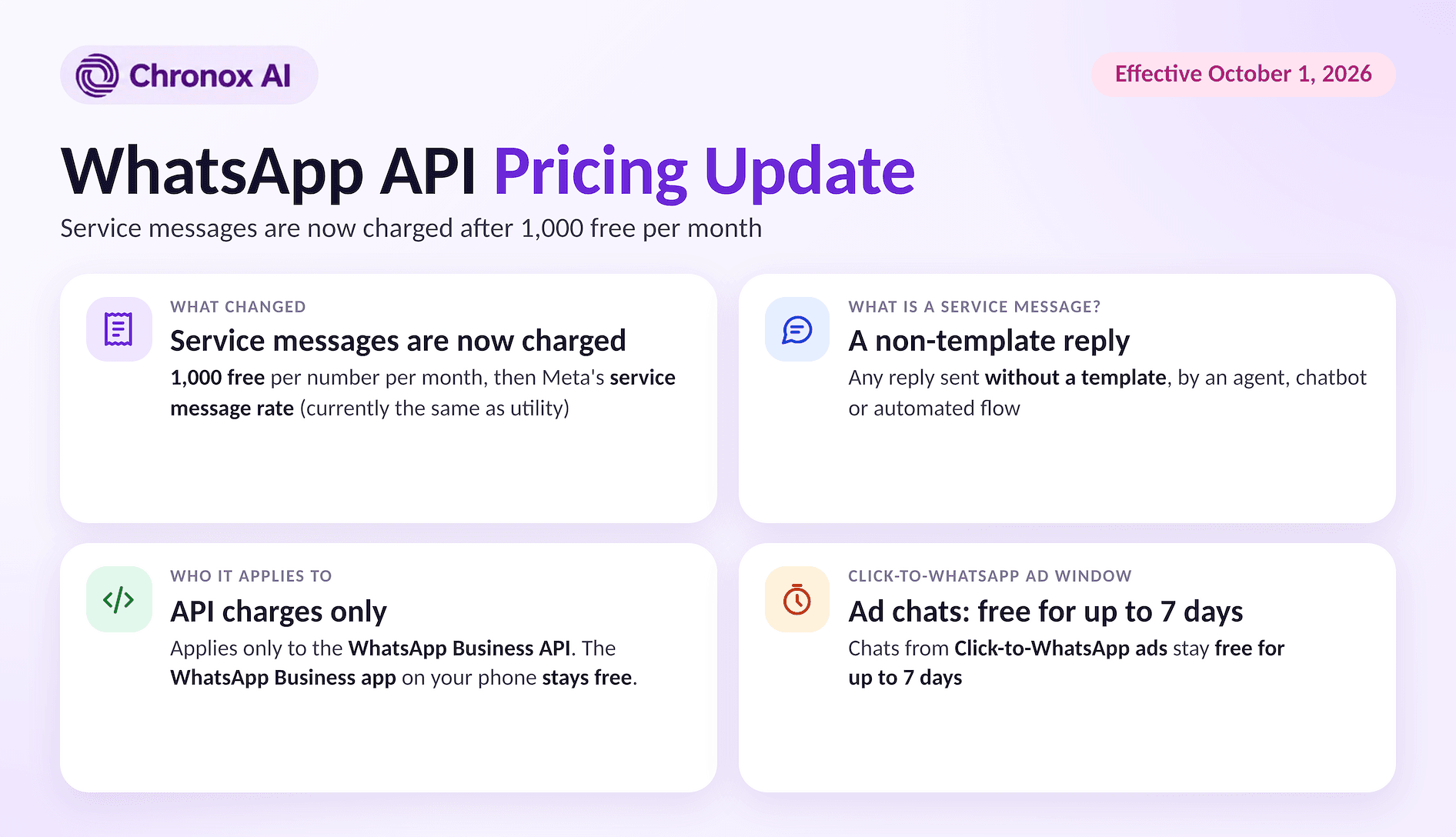
Since November 2024, replying to a customer on WhatsApp within 24 hours of their message has been free. That is changing. Effective October 1, 2026, Meta is making service messages on the WhatsApp Business Platform billable, with a monthly free allowance.
If your support, sales or order-update flows depend on the WhatsApp API, this affects your bill. This guide explains what is changing, who is hit hardest, and what to do about it.
Important: these charges apply only to the WhatsApp Business Platform (API). They cover messages sent through the Cloud API and Marketing Messages API. Messages you send from the WhatsApp Business app on your phone remain free. Even if your number uses both the app and the API, Meta confirms that messages sent from the app stay free, while messages sent through the API follow API pricing.
What Is a Service Message? WhatsApp Message Types Explained
Every message a business sends on the WhatsApp Business Platform falls into exactly one of five categories defined by Meta, and each message is charged only once, for its category. They split into two groups:
- Template messages: pre-approved messages you can send at any time, including to start a conversation. They are Marketing, Utility or Authentication.
- Non-template messages: free-form replies (text, images, buttons, lists and more) that you can only send inside an open 24-hour customer service window, which opens and resets each time the customer messages you. They are Service or Meta Business Agent messages.
| Category | What it is | Examples | How it is charged from Oct 1, 2026 |
|---|---|---|---|
| Marketing (template) | Promotional messages | Offers, new product launches, cart abandonment reminders | Per message, at the marketing rate |
| Utility (template) | Transactional or informational updates | Order confirmations, shipping updates, payment reminders | Per message, including inside the 24-hour window; volume discounts available |
| Authentication (template) | Identity verification | One-time passwords (OTPs), login codes | Per message; volume discounts available |
| Service (non-template) | Free-form replies by a person or a third-party AI chatbot | A support agent answering a question, a chatbot replying about order status | 1,000 free per phone number per month, then the utility rate; no volume discounts |
| Meta Business Agent (non-template) | Replies powered by Meta's own AI agent | Meta's agent answering product or store questions | Per token: $2.00 per 1M tokens (about 4–5 US cents per message) |
Tip: Meta assigns each template's category, and you pay the rate of the category applied when the template is sent. Review your templates' categories regularly; see Meta's guide to template categorization.
What Is Changing in WhatsApp API Pricing?
Here is what changes on October 1, 2026:
- Service messages become billable. Free-form replies sent within the 24-hour customer service window are charged per message, once you pass the free allowance.
- Utility templates in the service window are billable. These were free inside the window from July 2025 through September 2026. From October 1, 2026 they are charged.
- 1,000 free service messages per month. Each business phone number gets a monthly free allowance. It resets every month and unused messages do not roll over.
- Charged at the utility rate. Each service message beyond the free allowance costs the same as a utility message to the recipient's country.
- No volume discounts on service messages. Unlike utility and authentication templates, service messages are billed at a flat rate: 10,000 replies cost ten times what 1,000 do.
How Much Will Service Messages Cost?
Meta charges service messages at the same per-message rate as utility messages in each market. The rate depends on the country of your customer's phone number, not where your business is based. You can find the current rates for every market on Meta's official WhatsApp Business Platform pricing page.
Do Volume Discounts Apply to Service Messages?
No. Utility and authentication templates qualify for volume-tier discounts: the more you send in a market each month, the lower the per-message rate can go. Service messages do not have volume tiers.
Once you pass the 1,000 free messages, every service message is billed at the same flat rate, so 10,000 replies cost ten times what 1,000 do. For high-volume support teams, cutting unnecessary replies saves money directly.
For utility and authentication messages, tiers are counted per market and category across all WhatsApp Business accounts in your business portfolio, and reset every month. Only charged messages count toward a tier.
Volume tiers and thresholds for utility and authentication messages are listed on Meta's official pricing page.
Before vs After: At a Glance
| Message type | Until Sept 30, 2026 | From Oct 1, 2026 |
|---|---|---|
| Service (free-form) replies in 24-hr window | Free | First 1,000/month free per number, then billable |
| Utility templates in 24-hr window | Free | Billable |
| Marketing and authentication templates | Billable | Billable (no change) |
| Messages in the free entry point window (from Click-to-WhatsApp ads) | Free for 72 hours | Free for up to 7 days |
| Inbound messages from customers | Free | Free (no change) |
Action Required: Add a Payment Method
Meta asks businesses (and their Solution Providers) to add a payment method for their messaging accounts in Billing Hub by September 30, 2026. Without one, Meta still delivers service messages within your 1,000 free messages, but stops delivering them once the free tier is used up. Check your billing setup today so customer replies are not interrupted.
Exceptions Worth Knowing
- Government and non-profit organizations: eligible organizations keep free service messages beyond the monthly allowance, through December 31, 2027.
- AI Providers: the October 2026 service message changes do not apply to businesses covered by Meta's separate pricing policy for AI Providers.
- Free entry point conversations: when a customer messages you from a Click-to-WhatsApp ad on the WhatsApp Android or iOS app (not desktop or web), and you reply within the customer service window, a free entry point window opens from your reply and can stay open for up to 7 days. While it is open, marketing, utility, authentication and service messages are all free.
- Meta Business Agent is billed differently: replies powered by Meta's own AI agent are charged per token from August 1, 2026, at $2.00 per 1M tokens (about 4–5 US cents per message). The 1,000 free service messages do not apply to them, and they stay charged even inside the free entry point window.
- Third-party AI chatbots count as service messages: any non-template reply not powered by Meta Business Agent, whether sent by a person or your own AI solution, is charged as a service message. Your AI provider bills its usage separately.
- One charge per message: every message has a single category and a single charge. A non-template reply with promotional content is charged as a service message, not as a marketing template.
Other WhatsApp Pricing Updates to Note
- New standalone market rates from October 1, 2026: Meta moved nine markets onto their own rates. Bangladesh, Iraq, Nepal and Sri Lanka get lower utility and authentication rates; Kazakhstan, Kuwait, Morocco, Oman and Ukraine get higher ones. Other markets' rates also changed, so check Meta's rate card for the markets you message. Because service messages follow utility rates, service costs change too.
- India billing in INR: eligible businesses billed from India must move all WhatsApp Business accounts to INR by December 31, 2026. From January 1, 2027, Meta stops delivering messages from their non-INR accounts.
- Pricing changes follow a calendar: Meta updates prices only on January 1, April 1, July 1 or October 1, with at least one month's notice for rate changes.
Who Is Affected Most?
Low-volume businesses may see little or no change, since the first 1,000 service messages each month stay free. The impact is largest for:
- Support-heavy teams with long back-and-forth conversations
- E-commerce brands sending order, delivery and payment updates
- Chatbot and AI-agent deployments that answer high volumes automatically
- Businesses running many conversations from a single phone number
How to Keep WhatsApp Costs Under Control
- Measure your baseline. Check how many service messages and utility templates you send per number each month.
- Resolve faster. Fewer back-and-forth messages per conversation means fewer billable messages.
- Use buttons, lists and flows. Structured replies collect what you need in fewer messages than free-text exchanges.
- Combine updates. Send one consolidated order or status update instead of several small ones.
- Use free entry points. Conversations started from Click-to-WhatsApp ads open a free entry point window of up to 7 days in which messages are free; route conversations through them where it fits.
- Monitor spend continuously. Track message categories and volumes so a spike never turns into a surprise invoice.
How Chronox AI Helps
With Chronox.ai, you run WhatsApp as a controlled communication system rather than a message firehose. Conversation analytics, template performance tracking and user-level delivery status show where your messages go. Chatbots and automated flows help resolve queries in fewer messages, and our team can help you plan your template mix around the new pricing.
Conclusion
The October 2026 change does not make WhatsApp less valuable; it makes efficient conversations more valuable. Businesses that measure usage, design shorter flows and use free entry points will absorb the change easily.
FAQs
Q1. When do the new WhatsApp service message charges start?
October 1, 2026.
Q2. Do these charges apply to the WhatsApp Business app?
No. The charges apply only to the WhatsApp Business Platform (API). Messages sent from the WhatsApp Business app on your phone remain free, even if the same number is also connected to the API.
Q3. How many service messages are free?
The first 1,000 per business phone number each month. The allowance resets monthly and does not roll over. See Meta's free tier details.
Q4. Are customer messages to my business charged?
No. Inbound messages remain free.
Q5. Are utility templates inside the 24-hour window still free?
No. They were free from July 2025 to September 2026 and become billable from October 1, 2026.
Q6. What is the rate per service message?
It matches the utility and authentication rate for your market. Check Meta's official rate cards for your country.
Q7. What happens if I don't have a payment method on file?
Meta will still deliver service messages within your 1,000 free messages each month, but stops delivering them after the free tier is used up. Add a payment method in Billing Hub to avoid interruptions.
Q8. How can Chronox AI help?
By giving you visibility into message usage and automating flows that resolve conversations in fewer messages.


