


Introduction
For years, business growth followed a predictable formula: more customers meant more work, and more work meant hiring more people. Bigger teams were seen as a sign of success.In 2026, that model is breaking.Today's fastest-growing companies aren't scaling through headcount — they're scaling through AI-driven operations. With Chronox AI, businesses are managing customer conversations, automating payments, and streamlining workflows across WhatsApp, Instagram, Facebook, and websites without expanding their teams.
The Big Shift: From "More People" to "More Output"
The smartest companies today are asking a different question:"How do we scale output without scaling complexity?"The answer lies in AI-powered systems that automate execution.Instead of relying solely on larger teams, businesses are building systems that handle repetitive tasks automatically:
- Instant customer responses
- Automated payment follow-ups
- Self-running workflows
- Cross-platform chat automation
This isn't a future trend — it's already how modern businesses operate.Businesses adopting AI-driven operations report 30–40% reduction in operational costs, along with faster execution.
What AI-Driven Operations Look Like in Action
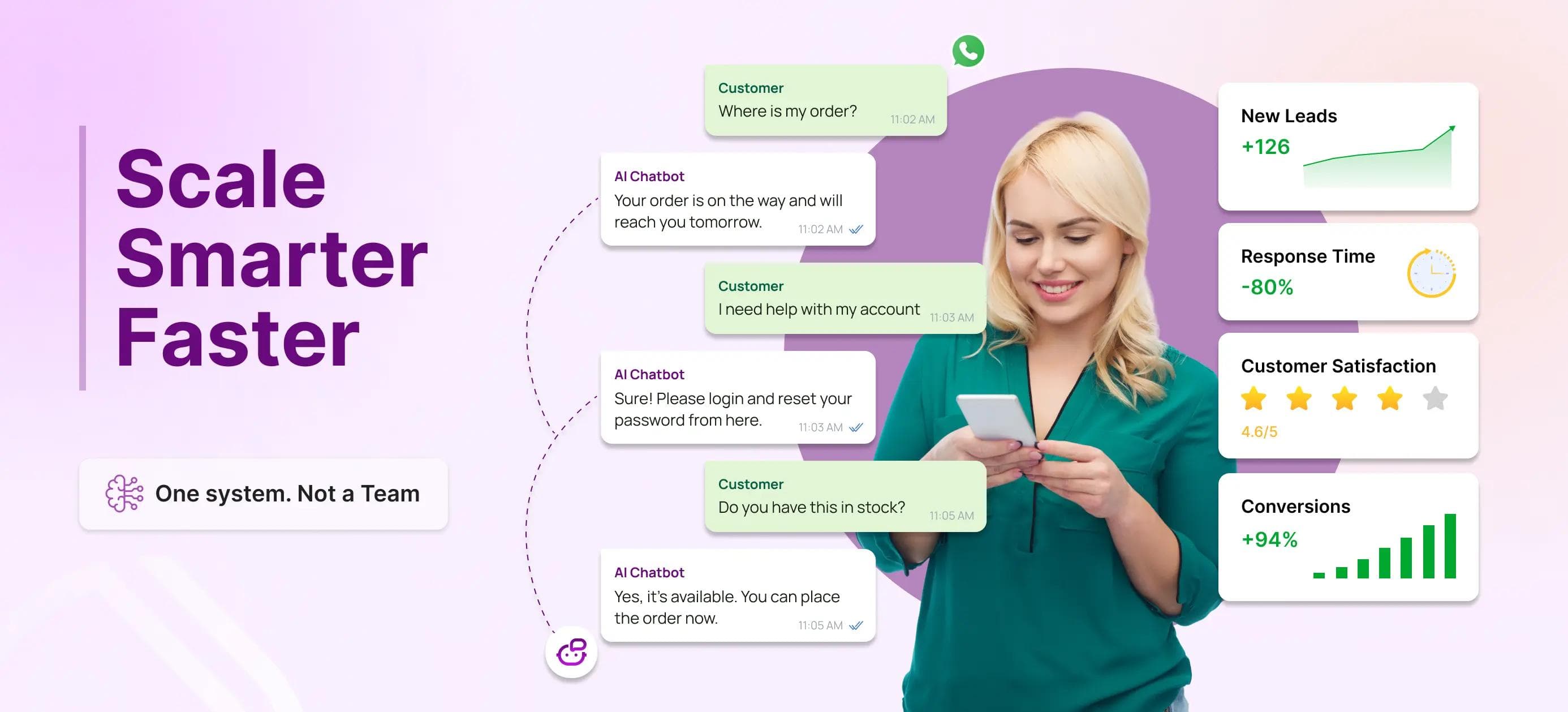
A customer messages your business at 11:30 PM:"Hey, is this product available?"Traditional Approach
- They wait
- You reply the next day
- The opportunity is gone
AI-Driven Approach
- Instant reply across all channels
- Product details shared
- Payment link sent
- Follow-up triggered
Result
The sale closes while your team sleeps.Businesses using AI-powered response systems improve response time by up to 3x, leading to higher conversions and better customer satisfaction.
Why Bigger Teams Alone Aren't the Answer
Bigger teams often create more moving parts—more coordination, more handoffs, more delays.In 2026, speed matters more than headcount. AI-driven operations help businesses stay fast, consistent, and scalable—without piling on complexity.
- Complexity: traditional scale increases complexity; AI simplifies workflows
- Speed: limited by human capacity; AI enables instant execution
- Efficiency: depends on coordination; AI runs automated processes
- Cost: grows with hiring; AI optimizes costs
What Smart Businesses Are Doing Differently
Companies using AI automation report up to 50% increase in productivity without increasing team size.✔ Cost Efficiency
AI reduces operational overhead while maintaining output.✔ Speed & Availability
24/7 responses across all major channels.✔ Consistency
Standardized communication, tone, and customer experience.✔ Scalability
Handle large volumes of interactions without added complexity.
The New Competitive Advantage: Smart Systems
In 2026, businesses are no longer defined by:
- Team size
- Budget
They are defined by:
- Speed of execution
- Workflow efficiency
- Ability to scale intelligently
Execution speed is becoming the key differentiator — and AI systems are enabling it.
Where Chronox AI Fits In
This shift toward automation-driven workflows is already happening through tools designed to simplify business processes.Chronox AI helps businesses turn customer conversations into automated workflows across WhatsApp, Instagram, Facebook, and websites.Instead of managing every interaction manually, businesses can:
- Automate conversations across multiple channels
- Respond instantly to inquiries
- Send product details, catalogs, and payment links automatically
- Trigger follow-ups and reminders
- Collect feedback within conversations
- Track everything from a unified dashboard
This doesn't replace teams — it amplifies them by removing repetitive work.
Industries That Benefit from Chronox AI
Chronox AI supports industries where customer interaction is key:
- E-commerce & Retail → Order inquiries, product discovery, cart recovery
- Healthcare → Appointment booking, reminders, patient queries
- Fintech → Payment reminders, onboarding, support
- Travel & Hospitality → Booking inquiries, itineraries, support
- Food & Restaurants → Orders, menu sharing, engagement
- Real Estate → Lead qualification, site visits
- Education & Services → Enrollment, follow-ups
Any business that handles customer conversations can benefit from automation.
What This Means for Businesses
If your growth strategy relies only on increasing team size, you may face:
- Rising operational costs
- Slower processes
- Increased complexity
Better approach:
- Identify repetitive tasks
- Automate them using AI
- Let teams focus on strategy and creativity
Businesses that adopt intelligent systems early are better positioned to scale efficiently — especially in fast-growing markets like India.
Conclusion
The future of business growth isn't about building bigger teams. It's about building smarter systems.AI-driven operations are not replacing people — they are reshaping how work gets done.The question is no longer:
"How many people do we need?"It becomes:
"How fast, efficient, and scalable can we become?"
FAQs
Q1. Can AI reduce the need for larger teams?
Yes. AI handles repetitive tasks, allowing teams to focus on high-value work.
Q2. How do AI-driven operations support business growth?
They improve efficiency, reduce response time, automate workflows, and enable scalability.
Q3. What tasks can AI automate?
Customer support, follow-ups, payment reminders, feedback collection, and workflows.
Q4. Is AI suitable for small businesses?
Yes, it helps small teams compete with larger organizations.
Q5. How does AI improve response time?
AI enables instant replies across WhatsApp, Instagram, Facebook, and websites.
Q6. What is the biggest benefit of AI systems?
Scalability with efficiency — handling more work without increasing team size.
Q7. Is AI expensive to implement?
Most tools are cost-effective and reduce long-term operational costs.


