


Introduction
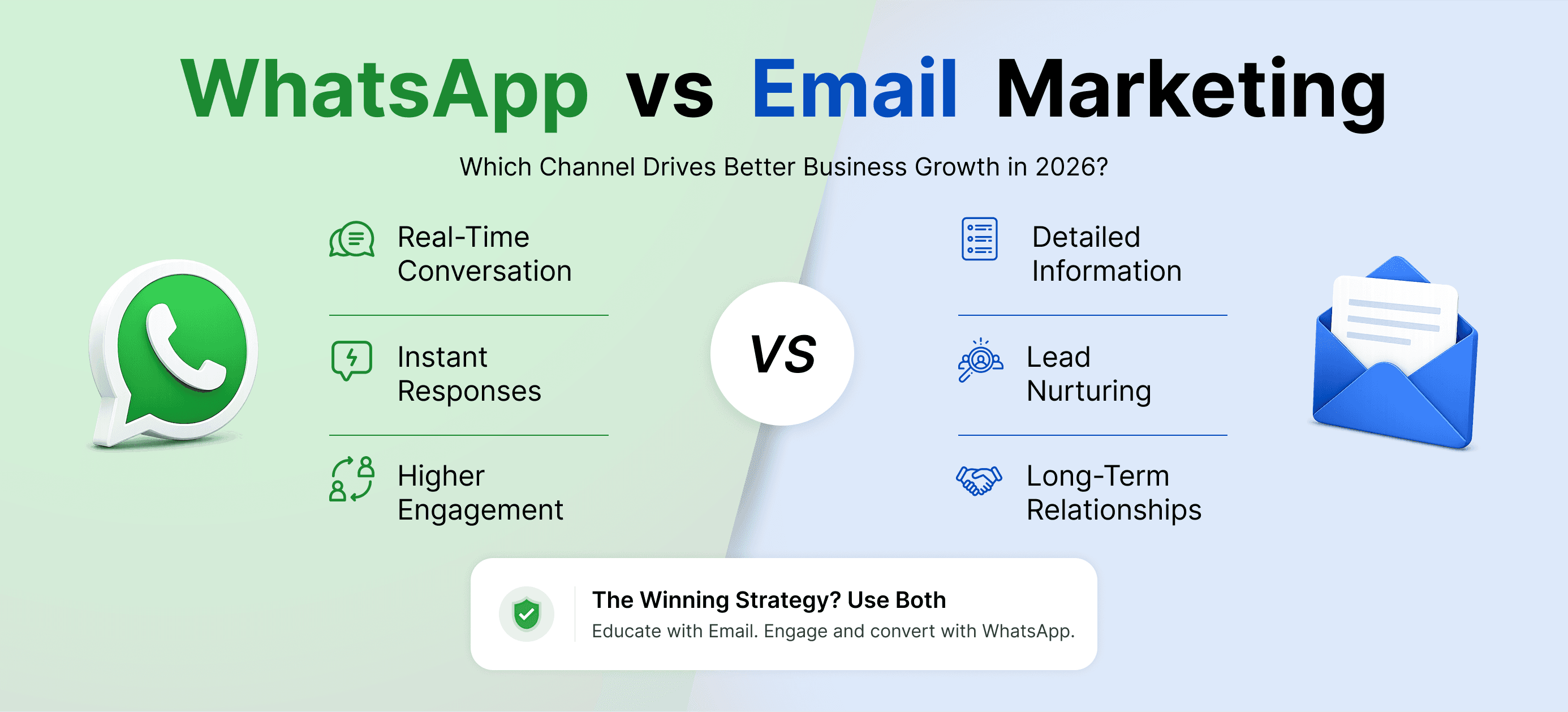
Businesses today have more ways than ever to connect with their customers, but two channels continue to dominate digital communication: WhatsApp Marketing and Email Marketing.Email has long been the preferred choice for newsletters, lead nurturing, product launches, and customer retention. Meanwhile, WhatsApp has transformed how businesses engage customers by enabling instant conversations, personalized communication, and AI-powered automation.So, which channel is better for business growth in 2026?The answer depends on your marketing goals. While email remains essential for building long-term relationships, WhatsApp excels at real-time engagement and faster customer interactions. Rather than choosing one over the other, many businesses are combining both channels to create a seamless customer experience.In this guide, we'll compare WhatsApp Marketing vs Email Marketing, explore their strengths, use cases, and key differences, and help you determine which channel—or combination of both—is best for your business.
What is WhatsApp Marketing?
WhatsApp Marketing is the practice of using WhatsApp Business or the WhatsApp Business API to communicate with customers, promote products and services, and build stronger customer relationships through personalized conversations.Businesses use WhatsApp to send promotional campaigns, answer customer queries, share order updates, schedule appointments, and automate follow-ups—all on a platform customers already use daily.With Chronox AI, businesses can automate these interactions using intelligent chatbots and workflows, helping them respond faster, reduce manual effort, and deliver personalized customer experiences at scale.Common use cases of WhatsApp Marketing include:
- Lead generation and qualification
- Promotional campaigns
- Customer support
- Appointment reminders
- Order updates
- Customer feedback and follow-ups
As customer expectations continue to shift toward instant communication, WhatsApp Marketing has become an essential channel for businesses looking to improve engagement and drive conversions.
What is Email Marketing?
Email Marketing is the practice of sending targeted emails to subscribers and customers to build relationships, nurture leads, and promote products or services.Businesses commonly use email to share newsletters, product launches, educational content, promotional offers, and customer updates. With advanced segmentation and automation, email campaigns can be personalized based on customer interests and behaviour, making them an effective channel for long-term engagement.While email remains a powerful tool for educating prospects and nurturing customer relationships, it typically lacks the immediacy and conversational experience that messaging platforms like WhatsApp provide.
WhatsApp vs Email Marketing: A Feature-by-Feature Comparison
Both WhatsApp Marketing and Email Marketing help businesses engage customers, but they serve different purposes throughout the customer journey. Understanding where each channel performs best can help you build a more effective marketing strategy.
1. Customer Attention: Which Channel Gets Seen First?
Getting your message noticed is the first step toward customer engagement.Email inboxes are often crowded with promotional messages, newsletters, and updates, making it challenging to capture a customer's attention. While email remains an effective communication channel, visibility can sometimes be a hurdle.WhatsApp messages, on the other hand, are delivered directly to a platform customers actively use throughout the day. This makes WhatsApp particularly effective for time-sensitive communication such as promotions, appointment reminders, order updates, and support notifications.
2. Real-Time Conversations vs Traditional Communication
Email is primarily designed for one-way communication. Customers may respond, but conversations are often slower and spread across multiple email threads.WhatsApp enables real-time, two-way conversations. Customers can ask questions, request support, confirm appointments, or enquire about products without leaving the app. Businesses using Chronox AI can automate these conversations, providing instant responses while reducing manual effort.
3. Which Channel is Better for Sharing Detailed Content?
When businesses need to educate customers or share detailed information, email continues to be the preferred choice.Product announcements, newsletters, case studies, guides, and long-form content are easier to consume through email, where customers can revisit the information whenever needed.WhatsApp is better suited for short, action-oriented messages that encourage customers to respond or take immediate action.
4. Automation and Scalability
Automation is essential for businesses looking to scale customer communication without increasing manual effort.Email Marketing platforms allow businesses to automate welcome emails, drip campaigns, and lead nurturing sequences.WhatsApp Business API, combined with AI-powered automation, enables businesses to automate customer support, lead qualification, appointment scheduling, reminders, and follow-ups through intelligent chatbots and workflows. Chronox AI helps businesses manage these conversations efficiently while delivering personalized customer experiences at scale.
5. Personalization: Which Channel Creates Better Customer Experiences?
Today's customers expect businesses to deliver relevant and personalized experiences rather than generic marketing messages.Email Marketing enables personalization through audience segmentation, allowing businesses to tailor campaigns based on customer demographics, interests, purchase history, and behaviour. This makes it ideal for nurturing leads and delivering targeted content at scale.WhatsApp takes personalization a step further by enabling real-time, one-to-one conversations. With Chronox AI, businesses can personalize responses, recommend products or services, answer customer queries instantly, and automate follow-ups based on individual customer interactions.Best for personalized customer experiences: BothEmail excels at personalized campaigns, while WhatsApp delivers personalized conversations. Together, they help businesses create more meaningful customer experiences across every stage of the customer journey.
WhatsApp vs Email Marketing Comparison
Here's a quick side-by-side comparison to help you understand where each marketing channel performs best.
| Feature | WhatsApp Marketing | Email Marketing |
|---|---|---|
| Primary Purpose | Instant customer communication and engagement | Lead nurturing and long-term relationship building |
| Visibility | High, with messages delivered directly to users | Moderate, as emails compete in crowded inboxes |
| Response Time | Instant, enabling real-time conversations | Slower, depending on when recipients check their inbox |
| Customer Engagement | High, with interactive and conversational messaging | Moderate, focused on one-way communication |
| Content Type | Short, action-oriented messages | Detailed content like newsletters, guides, and product updates |
| Automation | AI chatbots, automated replies, reminders, and workflows | Drip campaigns, welcome emails, and nurture sequences |
| Ideal For | Customer engagement & quick actions | Relationship building & education |
Key takeaway: WhatsApp Marketing and Email Marketing aren't competing channels—they serve different purposes. The right choice depends on your business goals, customer journey, and communication strategy.
Which Channel Delivers Better ROI?
When it comes to return on investment (ROI), there isn't a one-size-fits-all answer. The channel that delivers the best results depends on your business goals, audience, and marketing strategy.If your objective is to drive immediate customer actions—such as booking appointments, responding to promotional offers, requesting a demo, or resolving support queries—WhatsApp Marketing often delivers faster engagement through real-time conversations.On the other hand, Email Marketing excels at nurturing leads over time. It's ideal for sharing educational content, product updates, newsletters, and personalized campaigns that help build trust and guide prospects through longer buying journeys.Rather than choosing one channel over the other, businesses achieve the best results by using both strategically. For example, an email campaign can introduce a product or share valuable content, while a follow-up WhatsApp message can answer questions, provide personalized assistance, and encourage customers to take the next step.By combining both channels, businesses can engage customers at different stages of the journey, improve conversions, and create a more connected customer experience.
When Should Businesses Use WhatsApp or Email Marketing?
The effectiveness of WhatsApp and Email Marketing often depends on how they are used within a specific industry.
Healthcare
Healthcare providers often use Email Marketing to share health awareness campaigns, newsletters, and educational resources with patients.For time-sensitive communication such as appointment reminders, follow-ups, lab report notifications, and patient support, WhatsApp Automation offers a faster and more convenient experience. Chronox AI can further automate these interactions, helping healthcare teams reduce manual workload while improving patient communication.
Education
Educational institutions use Email Marketing to distribute admission brochures, course information, newsletters, and important announcements.For admission enquiries, counselling session reminders, application updates, and student support, WhatsApp Marketing enables instant conversations that keep prospective students engaged throughout the admission process.
E-commerce
E-commerce businesses rely on Email Marketing for product launches, promotional newsletters, and customer retention campaigns.WhatsApp Marketing complements these efforts by automating abandoned cart reminders, order confirmations, delivery updates, personalized product recommendations, and post-purchase support, helping businesses improve customer engagement and conversions.
Which Should You Choose?
The right choice depends on your business objectives.If your priority is educating customers, nurturing leads, and building long-term relationships, Email Marketing remains highly effective.If your focus is real-time engagement, customer support, appointment scheduling, and faster conversions, WhatsApp Marketing is the better option.For most businesses, combining both channels creates a more seamless customer journey and delivers better results than relying on either channel alone.
Conclusion
WhatsApp Marketing and Email Marketing are not competing channels—they each play a unique role in the customer journey.Email remains a powerful channel for building long-term relationships through newsletters, educational content, and lead nurturing. WhatsApp, on the other hand, enables businesses to engage customers instantly with personalized conversations, real-time support, and faster responses.Rather than choosing one over the other, the most successful businesses in 2026 are combining both channels to create a seamless customer experience. Email helps educate and build trust, while WhatsApp drives timely engagement and encourages customers to take action.With Chronox AI, businesses can enhance their WhatsApp Business communication by automating customer interactions, streamlining workflows, and delivering personalized experiences at scale.As customer expectations continue to evolve, businesses that integrate Email Marketing, WhatsApp Marketing, and AI-driven automation will be better positioned to improve engagement, strengthen customer relationships, and drive sustainable business growth.
FAQs
Q1. Which is better: WhatsApp Marketing or Email Marketing?
Both serve different purposes. WhatsApp Marketing is best for instant engagement and customer support, while Email Marketing is ideal for lead nurturing, newsletters, and detailed communication.
Q2. Can WhatsApp Marketing replace Email Marketing?
No, WhatsApp and Email complement each other. Businesses typically use email to educate customers and WhatsApp to drive faster conversations and actions.
Q3. When should businesses use WhatsApp Marketing?
WhatsApp Marketing is ideal for promotional campaigns, customer support, appointment reminders, order updates, follow-ups, and personalized customer engagement.
Q4. Which industries benefit the most from WhatsApp Marketing?
Healthcare, education, e-commerce, real estate, financial services, hospitality, and service-based businesses can all use WhatsApp Marketing to improve customer communication and engagement.
Q5. How does Chronox AI help with WhatsApp Marketing?
Chronox AI automates customer conversations, lead qualification, reminders, and support through AI-powered WhatsApp workflows, helping businesses improve engagement while reducing manual effort.


