


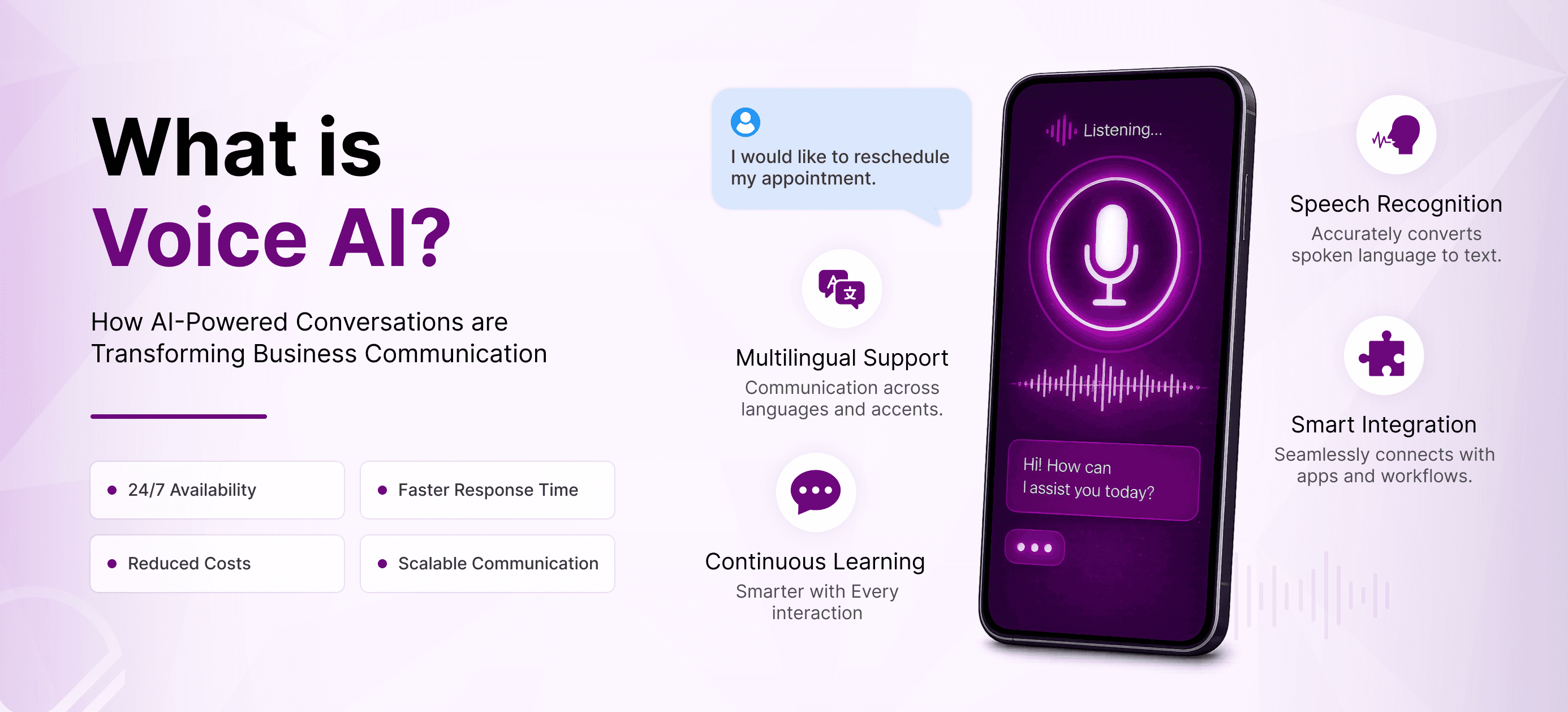
Introduction
Imagine calling a business and getting instant, accurate answers without waiting on hold or navigating endless phone menus. That's the experience Voice AI is making possible.As customer expectations evolve, businesses are adopting Voice AI to automate customer conversations, improve response times, and deliver personalized support at scale. From answering customer queries and scheduling appointments to qualifying leads and providing multilingual assistance, Voice AI is transforming business communication.Unlike traditional Interactive Voice Response (IVR) systems that rely on button-based menus, Voice AI understands natural language, recognizes customer intent, and responds with intelligent, human-like conversations. Powered by Speech Recognition, Natural Language Processing (NLP), Conversational AI, Machine Learning, and Text-to-Speech (TTS), it helps businesses automate customer support, sales, healthcare communication, and more.In this guide, you'll learn what Voice AI is, how it works, its key benefits, real-world use cases, and how to choose the right Voice AI platform.
How Voice AI Works
Although Voice AI conversations feel effortless, multiple AI technologies work together behind the scenes. These conversations are typically handled by AI voice agents that understand spoken language, identify customer intent, and complete tasks without human intervention.
1. Speech Recognition
The process begins when a user speaks into a phone call or voice-enabled device. Speech recognition technology converts spoken language into text that the AI can understand.
2. Intent Understanding
Using Natural Language Processing (NLP), the AI analyzes the text to identify the user's intent.For example:
- "Track my package.”
- "Where is my order?"
- "Has my delivery been shipped?"
Although these requests are phrased differently, the AI recognizes they all have the same intent.
3. Context Processing
The AI evaluates the conversation and determines the most appropriate response. It understands context, asks relevant follow-up questions, and uses previous interactions or available business data to deliver more accurate and personalized conversations.
4. Task Execution
Based on the customer's request, Voice AI can qualify leads, schedule appointments, update CRM records, send reminders, collect customer feedback, process routine enquiries, and automate business workflows. By integrating with CRM systems, helpdesk platforms, scheduling tools, and other business applications, it can complete these tasks in real time.
5. Voice Response
Finally, the AI converts its response into natural-sounding speech using Text-to-Speech (TTS) technology, enabling fast, conversational, and human-like interactions.This entire process takes only a few seconds, allowing businesses to deliver fast, personalized, and scalable customer communication without human intervention.
Why Voice AI Is Becoming Popular
The rapid adoption of Voice AI is driven by rising customer expectations and increasing business demands. Today, customers expect instant, personalized support, while businesses need to manage growing call volumes, reduce operational costs, and deliver consistent service.Traditional call centers often face challenges such as:
- Long wait times
- High operational costs
- Limited support availability
- Increasing call volumes
- Repetitive customer queries
Voice AI addresses these challenges by automating routine conversations, providing instant responses, and delivering 24/7 customer support. Beyond customer service, businesses use Voice AI for appointment scheduling, lead qualification, payment reminders, customer follow-ups, and other routine interactions, allowing employees to focus on higher-value work.Whether handling a few conversations or thousands simultaneously, Voice AI helps businesses scale customer communication without compromising service quality. As a result, organizations can improve customer satisfaction, increase operational efficiency, reduce support costs, and accelerate digital transformation with Chronox AI.
Key Benefits of Voice AI
Unlike traditional support teams, Voice AI operates around the clock, enabling businesses to provide instant customer support anytime without increasing staffing costs.
Faster Response Times
Voice AI answers customer queries instantly, resolves routine requests in real time, and significantly reduces wait times, resulting in a faster and smoother customer experience.
Reduced Operational Costs
By automating repetitive customer conversations, Voice AI lowers support costs, reduces agent workload, and improves operational efficiency, allowing teams to focus on more complex customer interactions.
Scalable Communication
Voice AI can handle hundreds or even thousands of conversations simultaneously while maintaining consistent service quality. This enables businesses to manage peak call volumes without additional resources.
Human-Like Customer Interactions
Modern Voice AI understands context, recognizes customer intent, and responds naturally, delivering personalized conversations that improve customer satisfaction and reduce frustration.
Multilingual Communication
Voice AI supports multiple languages and understands regional accents, enabling businesses to provide localized customer experiences, improve accessibility, and expand into new markets.
Increased Team Productivity
By automating routine conversations, Voice AI frees support and sales teams to focus on relationship building, complex problem-solving, and other high-value tasks, improving overall productivity.
Common Use Cases of Voice AI
Voice AI is transforming customer communication across industries by automating routine conversations, reducing response times, and delivering personalized support at scale. From handling customer queries to managing appointments and qualifying leads, businesses are using Voice AI to improve operational efficiency while enhancing the overall customer experience.
Customer Support
Businesses use Voice AI to answer frequently asked questions, register complaints, provide account information, track service requests, and route complex issues to human agents when needed. This helps reduce wait times, improve first-response efficiency, and deliver consistent customer support around the clock.
Healthcare
Healthcare providers use Voice AI to automate appointment scheduling, patient reminders, follow-up communication, prescription notifications, and general patient enquiries. By reducing administrative workload, healthcare teams can focus more on patient care while ensuring timely and personalized communication.
Sales and Lead Qualification
Sales teams leverage Voice AI to engage inbound leads, qualify prospects, schedule product demos, conduct follow-up calls, and update CRM systems automatically. This enables businesses to respond to leads faster, improve conversion rates, and ensure no sales opportunity is missed.
Banking and Finance
Financial institutions use Voice AI to send payment reminders, assist customers with account-related queries, verify customer information, provide loan or EMI updates, and automate routine support interactions. This improves service efficiency while maintaining secure and reliable customer communication.
Global Customer Support
Businesses serving customers across different regions use Voice AI to communicate in multiple languages, provide localized assistance, and deliver consistent support regardless of a customer's preferred language. This helps improve accessibility, enhance customer satisfaction, and expand into new markets without building large multilingual support teams.
E-commerce
Online retailers use Voice AI to provide order confirmations, delivery updates, return and exchange assistance, product-related support, and post-purchase follow-ups. By automating these interactions, businesses can deliver faster customer service, improve the shopping experience, and build stronger customer relationships.
Whether supporting customers, engaging prospects, or automating routine business processes, Voice AI helps organizations deliver faster, smarter, and more scalable communication across every stage of the customer journey.
Voice AI vs Traditional IVR
Many businesses still rely on traditional Interactive Voice Response (IVR) systems to manage incoming calls. While IVR is useful for basic call routing through predefined menus, it often creates a frustrating customer experience by requiring callers to navigate multiple options before reaching the right information or agent.
Voice AI offers a more intelligent approach. Instead of relying on button-based navigation and fixed scripts, AI voice agents understand natural language, recognize customer intent, and deliver human-like, context-aware conversations.
| Traditional IVR | Voice AI |
|---|---|
| Button-based menu navigation | Natural, conversational interactions |
| Follows predefined call flows | Understands natural language and customer intent |
| Limited to scripted responses | Delivers context-aware and dynamic responses |
| Primarily routes calls to agents | Resolves routine queries without human intervention |
| Frequent customer frustration | Provides faster, personalized customer experiences |
Unlike traditional IVR systems that primarily route calls, Voice AI can understand customer needs, automate business processes, and resolve routine enquiries in real time. This helps businesses reduce call handling time, improve customer satisfaction, and increase operational efficiency.
What Makes an Effective Voice AI Solution?
Not all Voice AI platforms offer the same capabilities. An effective Voice AI solution should go beyond answering calls by understanding customer intent, integrating with business systems, and automating complete workflows while delivering fast, natural, and personalized customer experiences.When evaluating a Voice AI platform, consider these key capabilities:
Natural and Human-Like Conversations
A good Voice AI solution should understand natural language, recognize customer intent, and respond conversationally rather than relying on predefined scripts. This creates more engaging interactions and improves the overall customer experience.
Fast and Accurate Responses
Customers expect immediate assistance. An effective Voice AI platform should process speech, understand requests, and provide accurate responses in real time to minimize wait times and ensure smooth conversations.
Context Awareness
Modern Voice AI should remember previous interactions within a conversation, understand context, and ask relevant follow-up questions instead of treating every query as a new request. This enables more personalized and meaningful customer interactions.
Seamless Business Integrations
The platform should integrate with CRM systems, helpdesk software, appointment scheduling tools, payment systems, and other business applications through APIs. This allows Voice AI to retrieve information, automate workflows, and complete tasks without manual intervention.
Multilingual Support
Businesses serving diverse audiences need a Voice AI solution that can communicate in multiple languages and understand regional accents. This helps deliver localized customer experiences while expanding support across different markets.
Analytics and Performance Insights
Comprehensive analytics, conversation summaries, and performance reports help businesses monitor customer interactions, identify improvement opportunities, and continuously optimize Voice AI performance.
Scalability and Enterprise Readiness
As your business grows, your Voice AI platform should be able to handle increasing call volumes, support multiple teams and locations, and maintain consistent performance without compromising service quality.
Choosing a Voice AI solution with these capabilities helps businesses automate customer communication, improve operational efficiency, and deliver exceptional customer experiences. Chronox AI combines these capabilities into a scalable Voice AI platform designed for modern businesses.
How Chronox AI Helps Businesses with Voice AI
Implementing Voice AI requires more than simply answering phone calls. Businesses need a solution that understands customer intent, integrates with existing systems, and automates conversations while delivering a seamless customer experience.Chronox AI provides intelligent Voice AI solutions that automate inbound and outbound customer interactions across industries. From answering customer enquiries and scheduling appointments to qualifying leads, sending reminders, and handling routine support requests, It enables businesses to deliver fast, accurate, and human-like conversations at scale.With seamless CRM and business application integrations, multilingual support, context-aware conversations, and real-time responses, it helps organizations automate workflows, improve operational efficiency, and enhance customer experiences.Whether you're in healthcare, banking, hospitality, e-commerce, or any service-driven industry, Chronox AI empowers your business to deliver faster, smarter, and more scalable customer communication.
Conclusion
Voice AI is transforming business communication by enabling faster, more intelligent, and personalized customer interactions. From automating customer support and appointment scheduling to qualifying leads and providing multilingual assistance, it helps businesses improve customer experience, increase operational efficiency, and scale communication with ease.As customer expectations continue to evolve, adopting a modern Voice AI platform is becoming essential for delivering exceptional customer service. Businesses across industries are using Voice AI to streamline operations, automate routine conversations, and build stronger customer relationships.If you're looking to modernize customer communication with intelligent AI voice agents, Chronox AI's Voice AI platform helps businesses automate conversations, improve response times, and deliver seamless, human-like customer experiences at scale.
FAQs
Q1. What is Voice AI?
Voice AI is a technology that enables computers to understand, process, and respond to human speech in real time through natural conversations.
Q2. How is Voice AI different from traditional IVR?
Unlike IVR systems that rely on button-based menus, Voice AI understands natural language and can handle dynamic conversations.
Q3. Which industries can use Voice AI?
Voice AI is commonly used in healthcare, banking, finance, e-commerce, travel, education, and customer support.
Q4. Can Voice AI support multiple languages?
Yes, modern Voice AI solutions can communicate in multiple languages, helping businesses serve diverse customer audiences.
Q5. What are the main benefits of Voice AI?
Key benefits include 24/7 availability, faster response times, reduced operational costs, improved customer experience, and scalable communication.
Q6. Can Chronox AI be integrated with existing business systems?
Yes. Chronox AI integrates with CRM systems, helpdesk platforms, scheduling tools, and other business applications, enabling businesses to automate customer conversations and workflows without disrupting existing processes.


