


Introduction
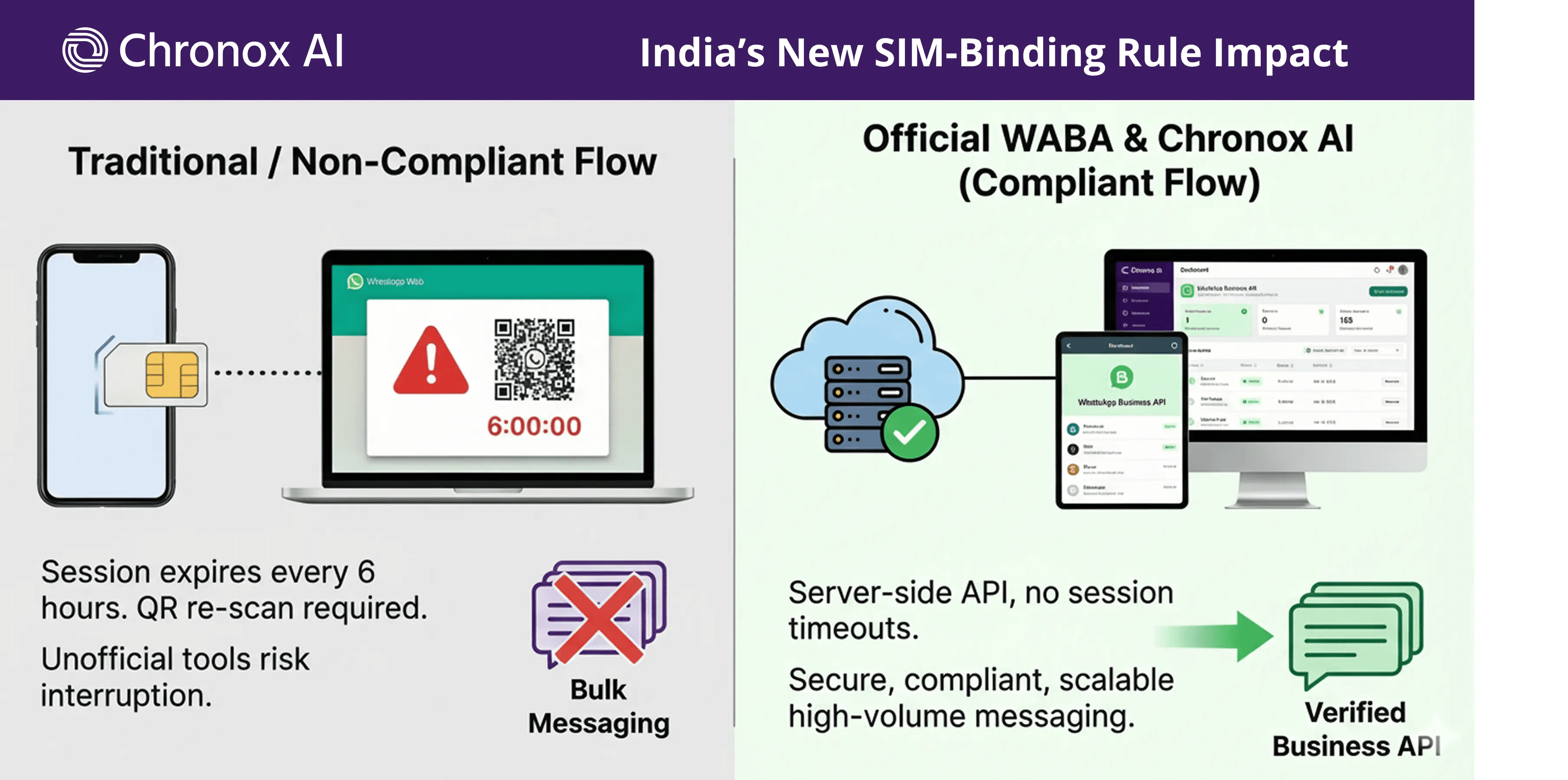
The Department of Telecommunications (DoT) India has introduced a new requirement for communication apps that use mobile numbers for identifying their users. Under this directive, apps must ensure that user accounts remain continuously linked to the SIM card used during registration. If the SIM is not present in the device, access to the service must be blocked.Additionally, web-based versions of these apps such as WhatsApp Web are now required to log users out periodically, with each session allowed to last a maximum of six hours. Users must reauthenticate to continue.These guidelines were issued in late November 2025, with a 90-day compliance period, meaning platforms must begin implementing these changes by early 2026.This article breaks down what these changes mean for everyday WhatsApp users, businesses that rely on high-volume messaging workflows, and companies using the official WhatsApp Business API (WABA).
Impact on WhatsApp Web and Daily Users
For many people, WhatsApp Web has become a convenient way to stay connected throughout the workday. With the new requirement:
- WhatsApp Web sessions will automatically end every six hours.
- Users must scan the QR code again to continue.
- The “always-on desktop experience” will be less seamless than before.
People who frequently switch devices, travel often, or operate their accounts across multiple browsers may feel this change more noticeably, as their sessions will require manual reconnection several times a day.
Implications for Sending Bulk or High-Volume WhatsApp Messages
With the new SIM-binding requirement and mandatory six-hour logout cycles for WhatsApp Web, several session-based methods used for large-volume messaging are likely to face disruptions.
🔄 Continuous Web Sessions Become Unreliable
Tools that depend on keeping WhatsApp Web active for long durations, whether for marketing, reminders, or customer outreach, will now be interrupted as sessions expire every six hours.
📱 Frequent QR Re-authentication
Re-scanning the QR code multiple times a day makes automation difficult and reduces the practicality of scheduled or repeated messaging tasks.
⚠️ Higher Risk for Unofficial Bulk Messaging Methods
Unofficial tools that rely on web sessions already violate WhatsApp's terms, and with the forced logout:
- Sessions will break more frequently
- Delivery reliability decreases
- The risk of number bans increases
✅ Best Practice: Use Official WhatsApp Business API
Platforms like Chronox.ai, built on the official WhatsApp API, provide a compliant and stable method to send high-volume messages without session issues.Benefits include:
- Consistent delivery
- No risk of session timeouts
- Significantly lower chance of number restriction
- Better campaign performance and analytics
- Fully policy-compliant communication
What This Means for WhatsApp Business API (WABA)
A relevant question is whether the new SIM-binding requirement could also include businesses using the official WhatsApp Business API.Based on how the directive is written and how WABA operates, it appears unlikely to be directly targeted, though there is still some possibility that it could fall within the broader interpretation of the rule.
Why There Is Some Likelihood WABA Could Be Considered
WABA requires:
- Business verification, and
- Phone number verification (via OTP or voice call)
Because the rule applies to services that identify users through mobile numbers, one could argue that WABA technically fits this definition at a registration level. This creates some room for interpretation, even though WABA is not consumed on a device like consumer messaging apps.
Why We Believe WABA Is Still Not the Primary Focus
The directive specifically addresses app-based communication services used on a device, where the SIM must remain present.
WABA, in contrast:
- Runs entirely through server-side APIs
- Does not create a device-bound session
- Does not require a SIM to be inserted in a phone
- Does not involve a user logging into an app on a handset or browser
Because of this architecture, the SIM-in-device requirement does not neatly apply to API-driven communication.
If WABA Is Ultimately Included
If regulators later clarify that WABA falls under the definition, the most practical implication would likely be:
- Re-authenticating the registered phone number every 90 days
Since WABA already supports OTP-based number verification during onboarding, such periodic checks would be operationally manageable and unlikely to create major disruption for businesses.
Current Outlook
The rule seems primarily aimed at preventing misuse in consumer messaging such as SIM swaps, anonymous access, or using apps without the SIM present.WABA does not follow these usage patterns, but because the TIUE framework remains broad, businesses should keep an eye on future clarifications.
How Chronox AI Future-Proofs Your WhatsApp Messaging
With the regulatory landscape shifting, choosing the right platform is no longer optional — it's survival. Chronox AI is built natively on the official WhatsApp Business API, meaning:
- Never logs out
- Never scans QR codes
- Never depends on browsers
- Never risks session expiry
- Never violates Meta policies
Additionally, Chronox gives you:
- Omnichannel AI agents that talk on WhatsApp, voice, and web chat
- Automated lead qualification
- Campaign orchestration
- Real-time analytics dashboards
- Enterprise-grade compliance
This regulation doesn't slow Chronox customers — it protects them.
FAQs
Q1. Will my WhatsApp Web automatically log out now?
Yes. Under the new SIM-binding rule, WhatsApp Web sessions are expected to be time-limited, with users needing to reauthenticate periodically (e.g., every six hours) to continue using it.
Q2. Are unofficial WhatsApp bulk tools still safe to use in India?
No. They already violate WhatsApp's policies, and with enforced session limits and SIM-binding, their reliability, delivery, and compliance risk will worsen significantly.
Q3. Does India's SIM-binding rule apply to WhatsApp Business API?
The rule mainly targets app-based, device-bound communication. WhatsApp Business API is server-side and SIM-independent in day-to-day use, so it is unlikely to be directly affected. However, periodic phone number verification could be required in future.
Q4. How does Chronox AI help with compliance?
Chronox AI is built on the official WhatsApp Business API, which is designed to be policy-compliant, server-based, and stable for high-volume messaging. This helps businesses stay ahead of regulatory changes like SIM-binding rules.


